
Impact of occupation in the West Bank: The trauma of home demolitions
By Revd Su McClellan
Home is much more than a shelter from the elements. It should be a place of safety, warmth and nurture, what the prophet Isaiah once imagined as “secure dwellings” (Isaiah 65:21). A place of belonging, self-respect and self-expression. Who we are, our hopes and dreams, our very sense of self is encapsulated in the place we call home.
Since 1947, 547,000 Palestinian homes have been destroyed in Israel and occupied Palestine.[1] The impact of this on Palestinian children, women and men is incalculable and the destruction is ongoing. In April of 2026 alone, 95 Palestinian structures were demolished in the West Bank by the Israeli authorities, displacing 140 people and impacting 350 others. There are a range of justifications given for the demolitions, but most common is that the houses were built without permits and are therefore ‘illegal’ (but getting permits from the Israeli authorities is all but impossible for Palestinians).
The trauma of losing a home is deep and long-lasting
Losing a home, through fire, flood, war etc, is widely recognised as a major traumatic event. According to Psychology Today, it “Deeply affects a sense of self”[2], a truth reflected by the psalmist in recollecting the experience of the exiles who sat and wept in a foreign land (Psalm 137:1).
Research in the West Bank shows that Palestinians who lose their homes to demolition experience clinically significant levels of PTSD, far higher than the general population. Shockingly around 7% of the population suffer PTSD symptoms, but among those directly exposed to trauma, including home loss, rates can rise to over half.[3] According to a report by Save the Children, rates can be as high as 70% among children, with children showing “high rates of emotional distress, with a majority reporting feelings of sadness, fear, depression, and anxiety… having frequent nightmares, feeling like there is no safe place for them, and paralysed with fear.”[4]
Fakhri’s story: A home that’s been in the family for generations, destroyed for a car park
In February of this year, I travelled with John Witcombe, the then Dean of Coventry Cathedral to Jerusalem, where we visited the Palestinian community of Al-Bustan in the Silwan area of East Jerusalem. We met with community leader Fakhri Abu Diab. His home has been demolished twice and Fakhri had just been served with yet another demolition order, this time for the portacabin he and his wife were now living in. Their home had been in their family since long before Israel occupied East Jerusalem in 1967, and now they were going to be forcibly displaced in order to make room for a car park for the Israeli settlers who have moved into Al-Bustan.
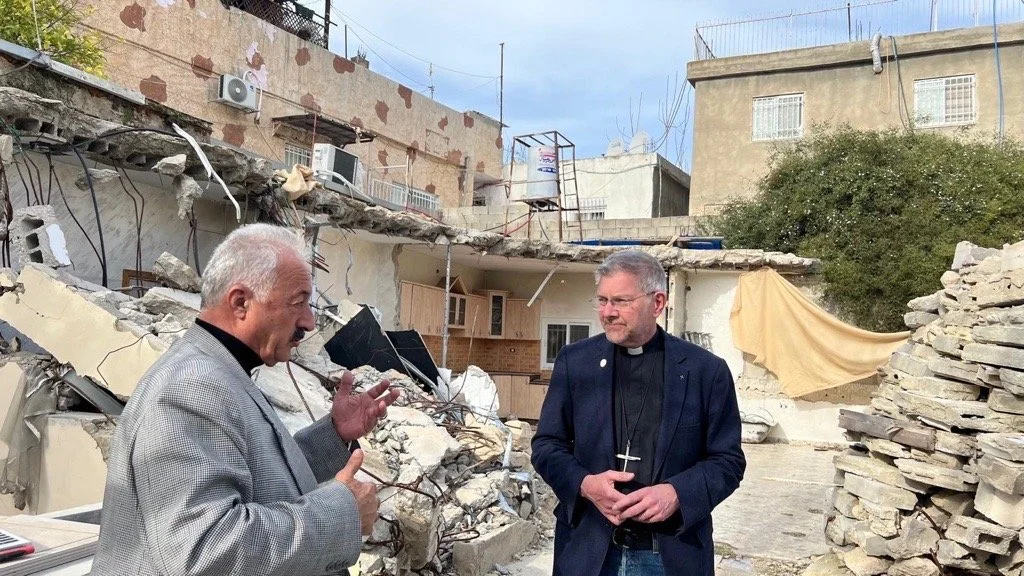
Fakhri showing the Very Revd John Whitcombe the remains of his demolished home.
On both occasions when the home was demolished, the entire electricity system was destroyed and it cost the couple 8,000 shekels (£2,051) to get reconnected. They have also been sent the bill for the demolitions, which amounts 43,000 shekels (£11,028) which includes the lunch costs of 380 police officers and their overtime payments, the cost of the bulldozers, and the fine for so called ‘illegal building’.
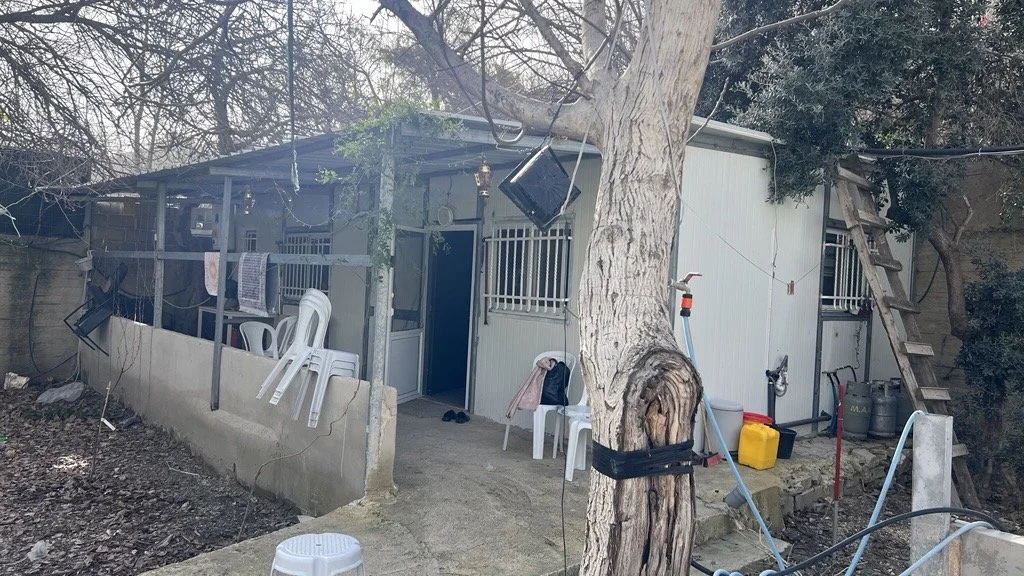
The portacabin Fakhri moved to following the demolition of his home was also given a demolition order.
Home demolitions in the West Bank are increasing
This couple’s story is far from unique. Fakhri is peacefully doing all he can to protect the neighbourhood, but demolitions are a daily reality as land is cleared to make way for Israeli settlers and a planned ‘biblical’ garden and theme park. This is prized land, sitting just south of the Jerusalem’s Old City walls, and with the backing of the city’s deputy mayor, Aryeh King, Palestinians are being forced out and more and more settlers are moving in. 2,000 Palestinians are at risk of losing their homes.
This is a story being repeated over and over again in the West Bank. Since the awful events of October 7th 2023, there has been a marked increase in unfettered settler violence, the seizure of property, home demolitions, and the forcible displacement and transfer of thousands of Palestinians by both the Israeli military and settlers. The UN has reiterated that“the Israeli Government’s assertion of sovereignty over the occupied West Bank and its annexation of parts of it are in breach of international law, as the International Court of Justice has confirmed.”[5]
The bible cannot be used to justify the destruction of homes
Sadly, scripture has sometimes been used to suggest that the displacement of Palestinians is somehow justified. Yet the wider witness of the bible calls us to a deeper and more searching truth. The God revealed in Jesus Christ does not show partiality but calls all people into the promise of life, dignity and belonging (Psalm 146:7–9). Again and again, the prophets speak out against those who “covet fields and seize them, houses and take them away” (Micah 2:1–2), reminding us that the misuse of power over land and home grieves the heart of God. In Christ, who himself had “nowhere to lay his head” (Matthew 8:20), we see a God who stands in solidarity with the displaced. The gospel opens salvation to all, and with it a call to justice that is not selective but universal, echoing God’s longing that all people might “build houses and inhabit them” in safety and peace (Isaiah 65:21). To follow Christ, then, is not to justify the loss of another’s home, but to uphold the sacred worth of every person and the right of all to live in dignity and security.
How Christians can respond – support the Stop Trade with Settlements Campaign
In the face of such ongoing loss, it can be hard to know how to respond. Yet our faith calls us not to turn away, but to act with compassion and integrity. As supporters of Embrace the Middle East, we are invited to stand alongside those whose homes and livelihoods are under threat by making thoughtful choices in our own lives. One small but significant step is to join Embrace’s Stop Trade with Settlements campaign and call on the UK Government to adopt legislation to explicitly ban trade with settlements and take an active step towards curbing Israel’s illegal settlement economy.
It is a tangible way of saying that every home matters, every life is precious, and that the peace we long for must be rooted in justice for all. In doing so, we echo the biblical call to seek justice and uphold the dignity of all.

Stop Trade with Settlements Campaign
Call on the UK Government to ban trade with Israeli settlements in the West Bank.
[2] https://www.psychologytoday.com/us/blog/two-takes-on-depression/202501/psychological-effects-of-losing-a-home-after-fire
[3] https://www.frontiersin.org/journals/psychiatry/articles/10.3389/fpsyt.2024.1443374/full
[4] https://resourcecentre.savethechildren.net/document/hope-under-rubble-impact-israels-home-demolition-policy-palestinian-children-and-their
[5] https://www.ohchr.org/en/press-briefing-notes/2025/11/occupied-west-bank-increased-israeli-violence-against-palestinians